
Puerto Rico is an unincorporated territory of the United States. It is situated in the Caribbean, around 1,000 miles (1,600 km) southeast of Miami and between the Dominican Republic and the U.S. Virgin Islands.
Puerto Rico has been a U.S. territory since 1898 when it was ceded by Spain as a result of the Spanish-American War. The inhabitants of Puerto Rico have been U.S. citizens since the passing of the Jones-Shafroth Act in 1917.
Puerto Rico, with an area similar to that of Connecticut (approximately 100 miles/160 km in length and 35 miles/56 km in width), supports a population of 3.2 million. The capital city of San Juan is home to about 500,000 people.
Puerto Rico is a U.S. territory that enjoys unique privileges
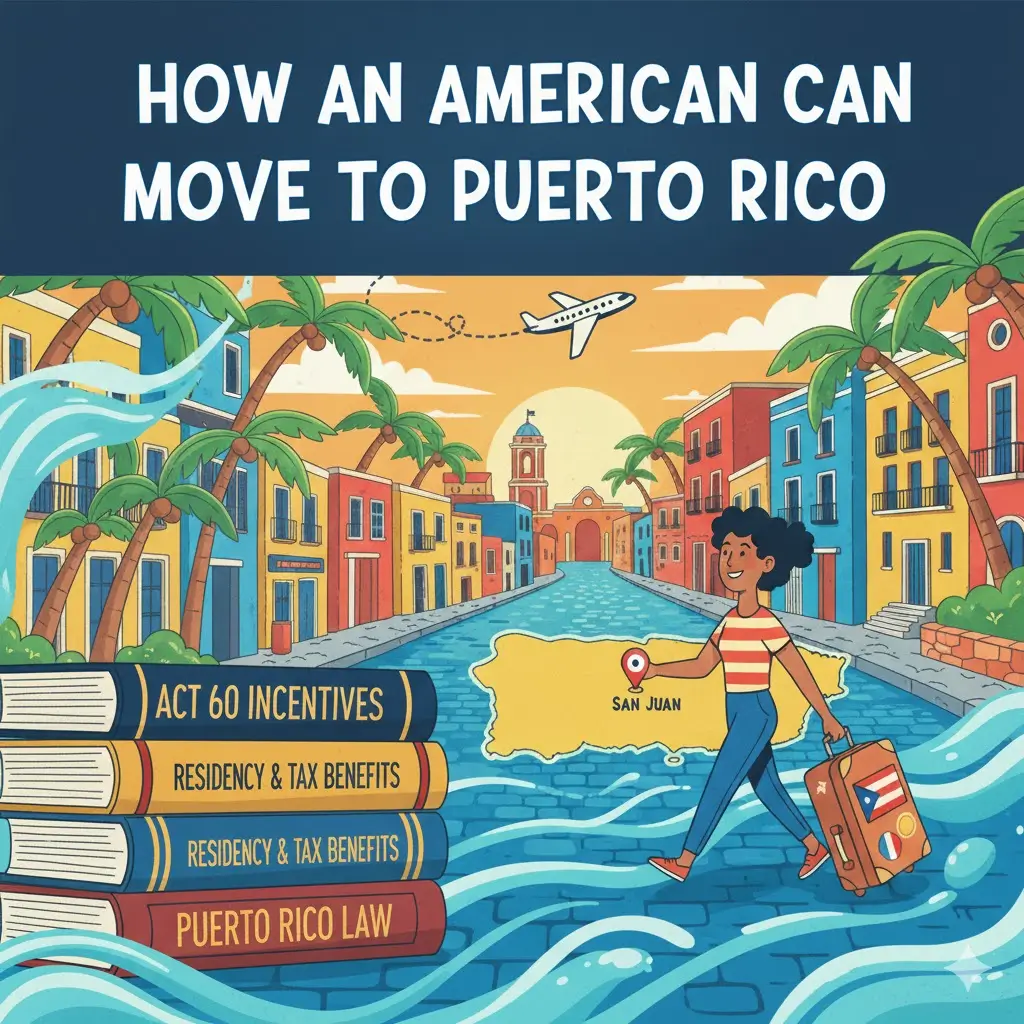
The territory of Puerto Rico complies with U.S. law, its currency is the USD, it has a USPS service, and its products can bear the “Made in USA” label. Banks enjoy FDIC insurance; federal regulations are in place as on the mainland. Puerto Rico retains its tax autonomy through its own constitution a main draw for American relocators.
The Most Important Advantage: No Visa or Passport Required
People who are U.S. citizens and decide to live in Puerto Rico have exactly the same situation as if they were moving from one state to another it is no more different than if they moved from California to Florida or from New York to Texas. You don’t have to:
- Get a visa or entry authorization
- Apply for a residence permit
- Go through immigration checkpoints
- Show a passport (an ordinary driver’s license or state ID is acceptable)
- Fill out immigration forms
- Get worried about residency limitations or deportation
Pack your belongings, book a ticket, and go. Legally, this is a domestic relocation, even though you’ll experience a new culture and tropical climate.
What You Need to Know about REAL ID
From May 2025, all travelers on U.S. domestic flights, including flights to Puerto Rico, will be required to show REAL ID-compliant ID (marked with a star in the corner) or a passport. Upgrade your ID at your DMV if you require it.
Customs and Luggage
There is no U.S. Customs (domestic flight), but Puerto Rico’s Hacienda will check the luggage. The whole procedure is quicker/more straightforward than the international one.
Your personal effects, household goods, cars, and pets can be brought in without the need for international papers. In the case of pets, certain conditions are in place: a veterinary health certificate issued no more than 10 days before the travel date and proof of rabies vaccination at least 30 days prior to the travel are mandatory. Moreover, the island authorities do not allow some dog breeds such as American Pit Bull Terriers and Staffordshire Terriers.
Step-By-Step Relocation: From the Decision to New Life
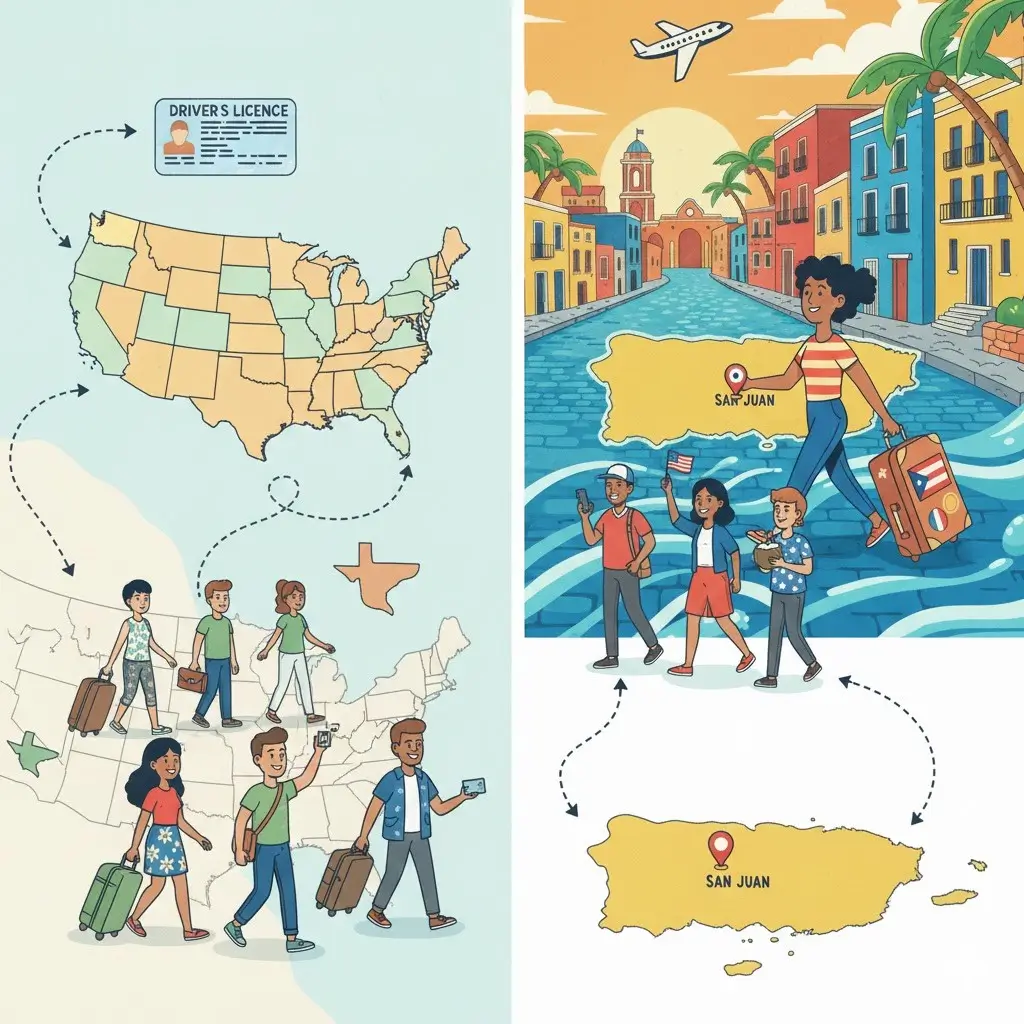
The relocation process may be broken down into a series of different stages once you are sure that it is what you want to do.
Stage 1: Gathering Information and Scouting Trip
Doing a reconnaissance trip is a must before you settle your mind on the decision. Puerto Rico is a very different place from one area to another and every area somehow conveys its own unique personality, its own set of pros and cons. Reserve 1-2 weeks for your trip and get acquainted with different parts of the island.
San Juan: everything you may need, infrastructure, restaurants, expat/digital nomad community, some American culture influences. Costs are higher + traffic is a problem.
Dorado is a seaside town west of San Juan that is famous for its golf courses and beach resorts. The town caters to the wealthy and attracts retired people with its upscale lifestyle, so the prices are accordingly.
Rincón located on the west coast is a paradise for surfers, lovers of the casual way of life and nature, who will also be delighted by the magnificent sunsets and great waves. It is thus perfect for people who want to leave the urban hustle.
Ponce, the second city in terms of size located on the southern coast, offers authentic Puerto Rican cultural and historical features at a much lower cost than San Juan, however, the level of the city’s infrastructural development is comparatively low.
Stage 2: Housing Search
Over the first few months of 2025, the prices of homes rose annually reflecting the high demand and scarcity of homes on the island. Median home price was ~$290k (vs. U.S. $398k); average rent ~$2,550 (vs. U.S. $2,100).
| City/Area | Average Rent (1-bedroom) | Average Home Price | Key Features |
|---|---|---|---|
| San Juan | $1,800 – $3,000 | $350,000 – $500,000 | Developed infrastructure, lots of jobs |
| Dorado | $2,500 – $4,500 | $500,000+ | Elite area, golf, high security |
| Rincón | $1,200 – $2,000 | $250,000 – $400,000 | Surfing, relaxed life, nature |
| Ponce | $900 – $1,500 | $180,000 – $300,000 | Traditional culture, affordable prices |
| Aguadilla | $1,000 – $1,700 | $200,000 – $350,000 | West coast, beaches, airport |
Here are some suggestions when looking for a house
You should consider using services provided by those real estate agents who are knowledgeable about the Puerto Rican market. The vast majority of mainland agents have little or no knowledge of the local market. A bilingual local agent can give you more listings than a mainland agent.
Look for Spanish-language sites rather than English tourist sites they have better prices and more variety. ClasificadosOnline.com is a well-known property listing site.
If you consider getting a house, you may first want to rent one for 2-3 months so that you can get to know the island and find a suitable place without haste.
Stage 3: Organizing the Move
After you have made your home choice, whether it is somewhere near the El Yunque rainforest or along the shores of Isla Verde, you are faced with planning the moving logistics. Our company Movers to Puerto Rico are experts in relocations to the island and will be able to take care of the ocean freight, the customs documentation as well as vehicle shipping for you. Household items are being packed professionally for ocean transport so that they will survive the Atlantic crossing.
It could be a good idea to use ocean freight if you move your whole household you are talking about sofas, kitchenware, family heirlooms, etc. Marine transport usually takes 2-6 weeks depending on origin (Florida shipments are faster than West Coast).
Our team takes care of all the necessary paperwork including customs clearance. Your personal manager will be there to assist you throughout the whole process so you can concentrate on settling in.
Get Your Car to the Island
Is it really necessary to send a vehicle along with your relocation? Most probably, yes. A couple of thousand dollars more will be the cost of an island vehicle compared to a similar one used on the mainland, due to logistical aid and taxes. Local car-dealer inventory is very limited and very often the condition of the vehicles is quite bad to be blamed on the air with salt presence.
Estimated cost of shipping vehicle:
| Shipping Route | Approximate Cost (USD)* |
| From Florida ports (Jacksonville, Miami) | 800 – 1,500* |
| From Northeast U.S. (New York, New Jersey) | 1,200 – 1,800 |
| From West Coast (California) | 2,000 – 2,500 |
*Call to confirm/arrange pricing: (939) 320-1415
To register your vehicle, in addition to your title and insurance, you will also need identification. The whole procedure usually takes about one week.
Tax Breaks: The Reason Behind the Boom

The biggest factor behind the boom is the Act 60 the most important tax incentive program of Puerto Rico. Being signed in 2019, it combined Act 20 (export services) and Act 22 (investors) in order to attract capital without imposing on U.S. citizens the necessity of renouncing citizenship.
Developed since then, it grants significant tax benefits to the residents of the island:
For Individual Investors (Chapter 2 of Act 60)
- 0% Puerto Rico income tax on capital gains accrued after establishing bona fide residency.
- 0% tax on qualifying dividends and interest from Puerto Rican sources.
- U.S. federal tax still applies to U.S.-sourced income.
For Businesses (Chapter 3 of Act 60)
- 4% tax on net income from export services (for companies with revenue > $3M)
- 2% tax for the first 5 years (for companies with revenue < $3M)
- Exemptions: property tax on business assets, municipal taxes, dividend tax.
Important 2025 Update: Act 60 terms are subject to legislative changes. Certain amendments affecting new decree holders are scheduled to take effect in 2026. Investors should confirm current rates and requirements before applying.
How the Tax Savings Work
Consider an investor with a $5 million stock portfolio selling for a $2 million profit:
| Scenario | Federal Tax | State Tax | Total Tax | Net Profit |
|---|---|---|---|---|
| Living in California | $476,000 (20% + 3.8%) | $266,000 (13.3%) | $742,000 | $1,258,000 |
| Living in New York | $476,000 (20% + 3.8%) | $219,000 (10.9%) | $695,000 | $1,305,000 |
| Living in Florida | $476,000 (20% + 3.8%) | $0 | $476,000 | $1,524,000 |
| Puerto Rico Resident (Act 60)* | $0 | $0 | $0 | $2,000,000 |
*Assumes: (1) bona fide Puerto Rico residency established before appreciation occurs, (2) gain is Puerto Rico–sourced under IRC §937, (3) full compliance with Act 60 requirements.
The difference between California and Puerto Rico residency: $742,000 savings on this transaction alone. For crypto investors, the benefits can be even more substantial. Selling a $10 million portfolio with $8 million in gains could save over $2 million in taxes.
Requirements to Qualify as a Bona Fide Resident
To take advantage of the tax benefits, one can’t just purchase real estate and claim residency. The IRS imposes three tests in order to determine whether someone is a bona fide resident of Puerto Rico:
Physical Presence Test
The individual has to be physically present in Puerto Rico for 183 days during the tax year. The alternative allows for a total of 549 days over three years, with a minimum of 60 days per year, thus providing more flexibility for those who travel frequently.
Tax Home Test
Your main place of business or work should be located in Puerto Rico.
Closer Connection Test
You must demonstrate that your closest personal and economic connections are with Puerto Rico rather than the mainland or a foreign country. This may include:
- Signing up to vote in Puerto Rico
- Getting a Puerto Rican driver’s license
- Joining local clubs and organizations
- Keeping the main bank accounts in Puerto Rico
- Having your family living with you on the island
- Vehicle registration in Puerto Rico
- Engaging in local community life activities
The IRS thoroughly assesses each point. Simply having a house and spending over 183 days in Puerto Rico is not enough. One has to really make Puerto Rico their main home.
Additional Requirements for Act 60 Participants
Participants of Act 60 must comply with further requirements:
Purchase of Real Property
You are required to buy a residential property in Puerto Rico within 24 months of getting your decree, which should be your personal residence. The ownership of the property needs to be in your name or jointly with your spouse not via a company or trust.
Charitable Donations
Making charitable donations of $10,000 to Puerto Rican nonprofit organizations annually is a must, with the focus of at least $5,000 on organizations that are combating child poverty.
Annual Report and Fee
It is necessary to submit the annual report to the Government of Puerto Rico and pay the $5,000 filing fee.
What the Tax Benefits do not cover
Tax incentives refer only to income generated after the establishment of Puerto Rico residency. They do not include the capital gains that arise from the investment made before the move, i.e., the unrealized gains will still be subject to U.S. tax when realized.
Example: Suppose Bitcoin was purchased before the establishment of the bona fide Puerto Rico residency; generally, that part of the gain which was accumulated prior to the move is still subject to U.S. federal capital gains tax. The rules concerning timing and sourcing are extremely complicated.
Sometimes, investors use a method similar to tax-loss harvesting called “sell and immediately repurchase” in order to reset their cost basis to the market value at present. This technique has flaws and consulting a qualified tax professional is a must.
Nevertheless, as per the current regulations, pre-move appreciation might qualify for a 5% Puerto Rico tax rate if the asset is disposed of at least 10 years after the establishment of the bona fide Puerto Rico residency and all the statutory requirements are met. The complicated rules of sourcing and timing are in operation.
Is It Worth It?
Act 60 is normally a good idea if you:
- Carry great unrealized capital gains (usually $500, 000+) or are going to have a big liquidity event
- Make high six-figure or seven-figure income through investment or export-service activities
- Are ready for the annual compliance, reporting requirements, and related costs
- Plan to establish authentic, long-term residency in Puerto Rico
The IRS has been putting a lot of effort into detection and audits of Puerto Rico residency taxpayers in recent times. Trying to exploit this as a tax strategy while your main place of living is Miami or Manhattan may result in audit, full tax reassessment, interest, and high penalties. The consequences are dreadful: full tax repayment including interest and penalties that may go beyond 25%, and there may even be a case for fraud charges.
Disclaimer: This article serves informational purposes only and doesn’t offer tax, legal, or financial advice. The outcome of taxes depends on each individual’s situation. A qualified tax professional should be consulted before making any decisions.
Practical Details: From Paperwork to Everyday Life
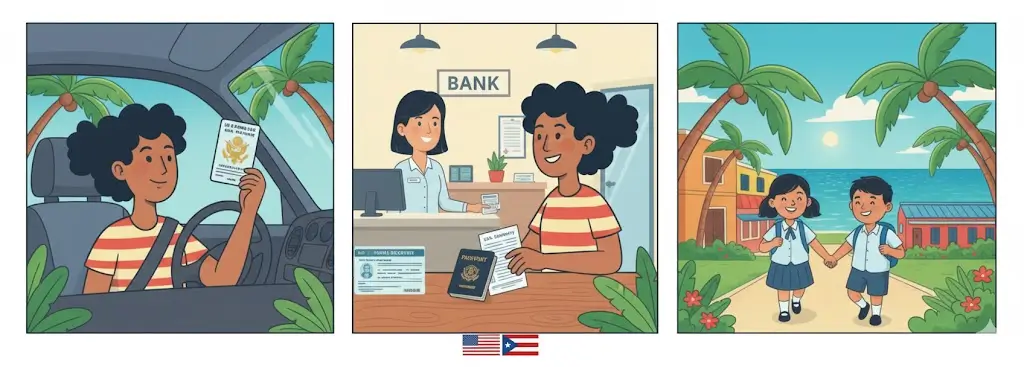
Changing Residency: Administrative Steps
Once you decide to permanently move to Puerto Rico, you will have to carry out several administrative steps to change your residence.
Driver’s License
You can use your U.S. driver’s license in Puerto Rico. To get a local license, you will have to pass a written test and a driving exam. The cost is $15, $25.
Voter Registration
Registering to vote in Puerto Rico shows that you are connected to the island and allows you to participate in local elections. You can register online or at a local office.
Social Security Number
If you have a Social Security number in the U.S., it will be valid in Puerto Rico there is no need for a change.
Bank Accounts
It’s easy to open a bank account in Puerto Rico. The most notable banks are Banco Popular, FirstBank, and Banco Santander. The requirements are the same as for banking in the mainland: a valid ID, proof of address, and a Social Security number.
Education for Children
The educational institutions should be of special concern to families with children who are relocating.
Public Schools
Public schools in Puerto Rico are primarily Spanish-speaking, and the quality of schools varies greatly. While some schools have sufficient resources, others are facing a lack of funding and infrastructure issues. Children who do not speak Spanish may find it difficult to adjust at first, but most of them will adapt and learn the language quickly.
Private Schools
Most American families send their children to private schools. There are schools that teach in English, and the tuition varies from $5, 000 to $15, 000 per year. Some of the schools that are popular among parents are:
- Baldwin School of Puerto Rico (English-language)
- Saint John’s School (bilingual)
- Colegio San Ignacio (prestigious Catholic school)
- Robinson School (international school)
Universities
There are different universities in Puerto Rico, e.g., the public University of Puerto Rico and a bunch of private ones. The students from the U.S. are eligible for federal aid just like the students from the mainland are.
Shopping and Consumer Goods
Large U.S. chains are everywhere in Puerto Rico, for example, Walmart, Target, Costco, Home Depot, and CVS, especially in the San Juan area. Amazon also delivers to the island; however, the shipping might take a little longer than the shipping to the mainland.
There are also large local malls, such as Plaza Las Américas in San Juan it is one of the largest shopping centers in the Caribbean.
Internet and Communications
You can rely on mobile coverage throughout Puerto Rico. The major U.S. carriers (AT&T, T-Mobile, Verizon) have the island as a part of their regular networks, so there are no roaming charges.
Broadband internet is accessible in most areas with a population. Claro and Liberty are the main providers. We can expect to see more and more fiber-optic high-speed internet in urban zones.
Step-by-Step Relocation Plan: Your Roadmap

If you want to proceed, here is your action plan:
6 – 12 Months Before Moving
- Research & Planning: Read about life in Puerto Rico, join expat Facebook groups, follow blogs, watch videos from current residents.
- Financial Assessment: Calculate your budget, including moving costs, cost of living, and potential savings.
- Consult a Tax Specialist: If considering Act 60, speak with an experienced tax attorney familiar with Puerto Rico law.
- Scouting Trip: Spend at least 1-2 weeks on the island. Explore different areas, view properties, feel the atmosphere.
- Housing Search: Decide on a preferred area and begin actively looking. Consider short-term rentals for the first months.
3 – 6 Months Before Moving
- Work/Income: If not working remotely, start looking for employment or plan your business on the island.
- Act 60 Application: If considering Act 60, confirm current deadlines and eligibility requirements before applying, as legislative changes may affect new applicants.
- Move Planning: Decide what to bring and what to sell. Get quotes from moving companies.
- Medical Preparation: Schedule a comprehensive check-up and ensure adequate medication for the transition period.
1 – 3 Months Before Moving
- Organize the Move: Call or write to us at (939) 320-1415.
- Administrative Tasks: Notify your employer (if applicable), close or transfer accounts, and cancel subscriptions.
- Documents: Gather essential papers including birth certificates, medical records, and financial documents.
- Vehicle: If shipping a car, arrange transportation.
- Farewells: Spend time with friends and family before leaving.
First Months After Arrival
- Formalize Residency: Get Puerto Rican driver’s license, register to vote.
- Banking: Open a local bank account.
- Utilities: Set up electricity, water, internet.
- Explore the Area: Learn the neighborhood, find favorite stores, restaurants, places to relax.
- Social Connections: Join groups, clubs, volunteer organizations. Meet people.
- Keep Learning Spanish: Practice every day!
- Document Residency: Keep detailed records of your presence for tax purposes.
Final Thoughts: Is This the Right Choice for You?
Many relocators thrive in Puerto Rico when the conditions are right: those who dream of the island living, those who are looking for substantial tax savings, those who work remotely or have location-independent income, and those who are willing to adapt culturally.
Remember: relocation is not permanent. If the island lifestyle doesn’t suit you, you can always go back to the mainland. You will not know if this could be a life-changing move for you unless you try it.
Do you want to explore? Go and check out the island. The beaches, the Caribbean waters, and new adventures are waiting for you.
¡Bienvenidos a Puerto Rico!
Final Tip: Plan carefully, consult professionals (especially tax experts), and keep an open mind. The best adventures start with a bold step into the unknown.
¡Buena suerte!
Paperwork and residency are one part of the move. Getting your furniture across the water is the other. We price moves by volume, not weight, and you can see the range for a home like yours on the Movers to Puerto Rico home page — pick your region and how much you are moving, no form required. Or call (939) 320-1415.

Leave a Reply